
 Avalon Peninsula
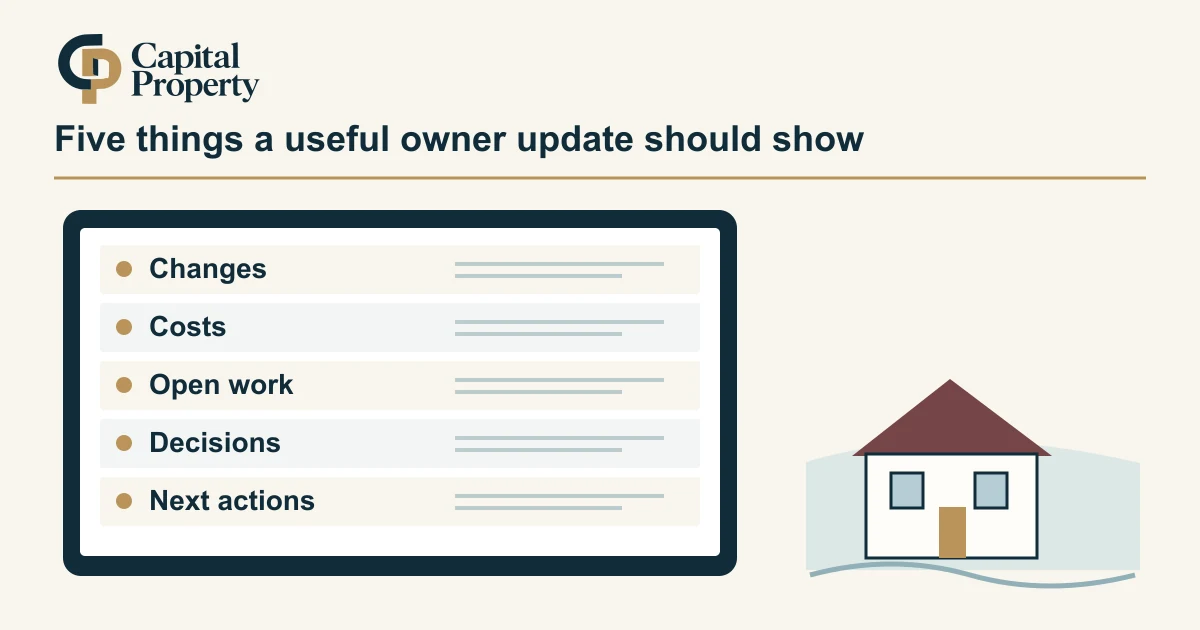
Living away from your rental property should not mean piecing together its condition from scattered messages. A useful owner update lets you see what changed, what remains open and whether you need to make a decision.
The aim is straightforward: enough information to exercise oversight without taking back the daily coordination you chose to delegate. For a Newfoundland owner living elsewhere, that can mean fewer questions about whether a contractor attended, what an expense covers or who is following up.
Here is a practical structure to discuss with a property manager. The format, frequency and service responsibilities should fit your agreement rather than an assumed universal standard.
By Capital Property. Updated .
Start with a short summary of what changed
A report should quickly distinguish an uneventful period from a period with outstanding work. Begin with a small summary:
- Important changes since the previous update.
- Work completed and anything still being checked.
- Open issues and the next action for each.
- Decisions needed from the owner.
- Work or costs expected in the next reporting period.
A summary does not need to repeat every routine exchange. It should direct you to the items that deserve attention. If nothing material changed, say that plainly and carry forward any unresolved items so they remain visible.
Give every open item a useful status
“Maintenance being handled” leaves several questions unanswered. Has someone assessed the problem? Is a quote pending? Is a visit booked? Has the work actually finished?
Agree on status labels that describe real progress. A simple sequence might be reported, assessment arranged, quote pending, approved, scheduled, completed, follow-up required. Different jobs will need different steps; the purpose is clarity, not extra administration.
For each open item, include the next action, who is responsible and the expected update point. If the date is uncertain, explain what it depends on. A supplier's availability is different from a confirmed appointment, and the report should make that distinction clear.
Make the financial figures understandable
Money figures need context. Ask the report to distinguish amounts received, expenses paid and costs that are estimated, approved or still awaiting an invoice. Otherwise, a planned repair and a paid repair may look identical.
Supporting records should make an unfamiliar charge understandable without requiring a separate conversation. The owner should be able to identify what the work related to, the relevant period and where the invoice or explanation is stored.
Also agree how balances, transfers and any funds held for property expenses will be presented within your arrangement. Do not treat a single month's cash movement as a complete measure of investment performance. Its value here is helping you understand what happened and what may require attention next.
Show enough evidence to explain the work
Photographs can help an owner understand a reported condition or completed job, but an image without context can be misleading. Useful supporting information identifies what is shown, when it was recorded and why it matters.
For example, a contractor's completion note and a relevant photograph may help explain a repair. They do not automatically establish that every underlying issue has been resolved. If a further check is planned, the update should say so.
Keep evidence proportionate. Owners rarely need a large collection of near-identical photographs or personal details about occupants. Use the information necessary to understand the property's condition, the agreed work and any remaining question.
Put owner decisions in one clear place
If you need to decide something, the request should be easy to find. A decision-ready item explains:
- What decision is required.
- The options and available supporting information.
- Any recommendation and its reasoning.
- The known cost or current estimate, clearly labelled.
- When the answer is needed and what happens while it is pending.
Your manager's role and authority still come from the agreement. Reporting should not quietly expand either. Work within agreed authority can be documented; matters reserved for you should follow the agreed approval process.
Use a compact example
Illustrative example only: this is not a Capital Property client report or a promised reporting format.
| Item | Current position | Next action | Owner input |
|---|---|---|---|
| Reported kitchen leak | Contractor visit scheduled; cause not yet confirmed | Local coordinator to obtain findings after attendance | No decision requested at this stage |
| Proposed exterior work | Written estimate received; work not booked | Manager to clarify what work the estimate includes | Review the estimate once the clarification arrives |
| Previously completed repair | Completion note received; follow-up check pending | Coordinator to record the agreed check outcome | None currently |
Notice that a scheduled visit is not described as a completed repair. The owner can see both progress and uncertainty without calling everyone involved.
Keep routine reporting separate from urgent contact
A regular summary is useful for oversight, but it should not be the route for issues needing prompt attention. Agree which events require direct contact, which channel will be used and what happens if you are unavailable.
For owners in a different time zone, include practical availability and a verified backup arrangement. Avoid relying on someone noticing a message buried in a routine report. Equally, agree which ordinary matters can be handled within scope and summarised later, so every small task does not become another interruption.
Review the report with five questions
When your next update arrives, ask: What changed? What remains open? Are the costs clear? Do I need to decide anything? Who owns the next action?
If an answer is missing, request a specific improvement rather than simply asking for “more detail.” A clear next-action date may be more useful than another page of commentary. Over time, the report should become easier to scan because its structure stays consistent.
For the wider planning questions, read Capital Property's guide to managing property from outside Newfoundland. You can also explore Capital Property's management approach. To discuss the support your property needs, request a free property assessment.
The goal is to know enough to make sound decisions while someone accountable handles the agreed coordination locally. Clear updates help you keep that balance.
General information only; not legal advice or a substitute for professional assessment.