
 Avalon Peninsula
Moving into a rental in St. John's, Mount Pearl or Paradise involves several expenses. The security deposit should be easy to identify among them. A payment request that simply says “move-in money” leaves both sides guessing about what has been paid and why.
Sources checked . Check the linked sources for later changes.
Start with a clear payment breakdown
Before money changes hands, separate the regular rent payment from the security deposit. Record the rental address, the tenancy type and the amount assigned to each. Keep the agreement and payment record together. This helps a renter check the request and helps an owner maintain a file that someone else can understand later.
This guide concerns residential tenancies covered by Newfoundland and Labrador's Residential Tenancies Act. If the accommodation's status is unclear, start with the provincial Landlord & Tenant hub rather than assuming a rule applies to every arrangement.
How much can the security deposit be?
The province's security-deposit guidance sets out these maximums:
| Tenancy | Maximum security deposit |
|---|---|
| Week to week | Two weeks' rent |
| Month to month | Three quarters of the first month's rent |
| Fixed term | Three quarters of the rent payable for the first month when divided into monthly payments |
Can a landlord charge an additional pet deposit?
Separate security deposits for items such as pets do not create extra room above the permitted maximum. The landlord must provide a written deposit receipt identifying the amount, payment date and premises. Official security-deposit guide.
Fictional example: A monthly St. John's apartment rents for $1,600. Three quarters is $1,200. A request for a $1,200 security deposit plus another $300 pet security deposit would exceed that limit. The example illustrates arithmetic, not a typical local rent or a statement about whether pets must be accepted.
For weekly rent, use the actual weekly figure rather than multiplying a monthly figure by an approximate conversion. If the agreement and the payment request describe different tenancy types, resolve that discrepancy before relying on the calculation.
Is “first and last month's rent” allowed?
Section 12 prohibits a landlord from requiring or accepting prepaid last-week or last-month rent. Ordinary first-period rent and a lawful security deposit are different payments. Residential Tenancies Act, section 12.
Do not copy a move-in payment template from another province. For either party, a useful question is: “Please identify which payment is rent for the current period and which is the security deposit.” Keep the answer with the original request.
Calling money something else does not resolve uncertainty about its purpose. Where a holding fee, additional deposit or bundled charge is proposed, ask Residential Tenancies to clarify the arrangement before treating it as a standard part of signing.
Deposit receipts, interest and records
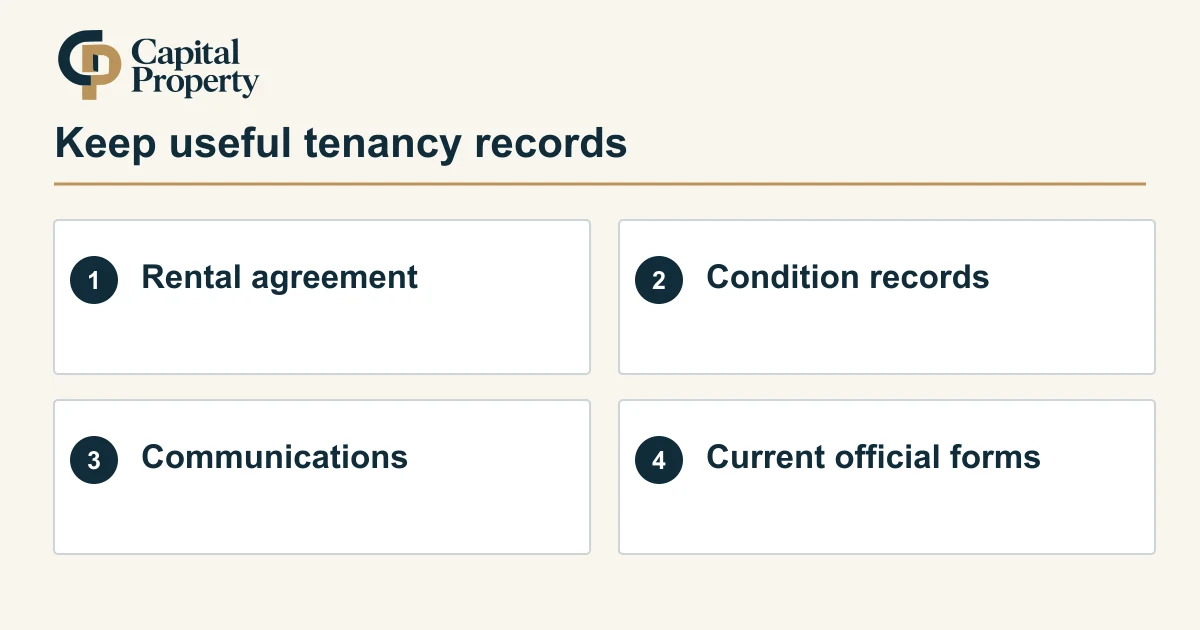
A practical deposit file can be small:
- Rental address and tenancy start date.
- Agreement showing rent and tenancy type.
- Deposit receipt and proof of payment.
- A separate running deposit balance and interest record.
- Move-in condition report and indexed photographs.
- Relevant repair correspondence and later agreements.
- Move-out date, final correspondence and repayment record.
Owners should not treat the deposit as available operating cash. The Act requires deposit into an interest-bearing account in the province within two banking days; at three or more residential premises, the account must be exclusively a security-deposit trust account. Prescribed interest must be credited. Act, section 14.
Use the official hub's current interest information rather than hard-coding an interest rate into a reusable spreadsheet. Write down the source and calculation date. Renters can keep their own payment record without needing access to an owner's banking information.
When must a security deposit be returned?
The Act's return clock runs from vacating the premises: return within ten days unless the landlord has a claim. A claim can be resolved through a written agreement or an application to the Director. If a tenant applies, the landlord has ten days after service to apply in response for the deposit; otherwise it must be returned. Act, section 14(9)–(15).
Record the actual move-out and handover facts, not just the end date printed on the original lease. Do not interpret the claim exception as permission to leave the matter unresolved indefinitely. Use the official applications and forms and seek prompt guidance if a claim or deadline is involved.
A useful move-out reconciliation
Prepare a short statement that another person could follow:
| Item | What to record |
|---|---|
| Starting balance | Deposit received and receipt reference |
| Interest | Calculation period, source and amount |
| Proposed claim, if any | Specific issue, amount and supporting records |
| Agreement or application | Document reference and relevant dates |
| Amount returned | Amount, payment date and confirmation |
| Unresolved point | What remains disputed and the next action |
Fictional example: A move-out photo shows a marked cupboard door. The move-in record already identifies the same mark. Put those records side by side before discussing a charge. A later photograph alone does not explain when a mark appeared or establish who is responsible.
Keep observations separate from conclusions. “Scratch visible on lower door” describes a condition. “Tenant owes replacement cost” is a claim requiring its own basis. Do not present a proposed deduction as an agreed amount when it remains disputed.
If the parties disagree
First make the disagreement specific: the balance, interest, condition, proposed amount or repayment status. Preserve the original documents and write a short timeline. The province's evidence guidance explains that records must be relevant and properly provided; a large photo collection does not guarantee a result.
An owner should avoid replacing a claims process with an unexplained deduction. A tenant should avoid assuming this guide authorizes stopping regular rent payments. Obtain guidance about the particular issue and applicable procedure.
Common questions
Does a clean walkthrough guarantee a full refund?
Do not promise an outcome from a checklist alone. Keep the condition record alongside payment records and any other relevant documents, then reconcile the actual tenancy.
Can both sides use the same checklist?
Yes. A shared structure makes differences easier to identify. Each party should keep its own copy, including any disagreements rather than removing them from the record.
Where should I start if the amount looks wrong?
Ask for an itemized explanation and compare it with the tenancy type and official guidance. For a disputed demand or proposed remedy, contact Residential Tenancies before acting.
General information, not legal advice. Confirm current rules and obtain advice about a specific dispute.